Impact of Sludge-Based Organic Amendments on Growth Performance of Spinach (Spinacia oleracea)
Acharya Balkrishna , Ajay Kumar Gautam , Nidhi Sharma , Vedpriya Arya and Rohini Bhat
Volume-3, Issue-1, Jan.-Dec., 2026 3(1): 01-08
 Download Pdf
ABSTRACT
The application of sewage sludge in agricultural fields has proven very beneficial for enhancing soil fertility and supporting better crop growth due to its rich nutrient and organic matter content. This study aims to assess the impact of different organic amendments, using Ganga sludge as the main material, on the growth performance of Spinacia oleracea plants.
Among the seven treatments tested, sludge-based organic amendments such as Dharti ka Chowkidar (T3) and Jaivik Khad (T5) proved to be effective supplements for spinach, as shown by significant improvements in yield parameters. Plant height, total fresh weight, yield, and dry matter of the leaves all increased with these treatments compared to the control.
The iron content in the leaves increased by more than three times across all treatments. This study demonstrates that applying sludge-based organic amendments can effectively increase spinach production, highlighting its potential to improve agroecosystems and support proper waste management.
Keywords: Sludge, Soil biochemistry, Growth performance, Iron content, Spinach.
INTRODUCTION
The River Ganga holds a significant position as one of India’s largest perennial rivers, serving as a guardian of the cultural heritage within the Indian subcontinent. It plays a vital role in sustaining the livelihoods of countless individuals residing in the vicinity of its expansive river basin (Singh and Singh 2020). However, alongside its immense utility, the river also bears the burden of receiving an extensive amount of untreated effluent discharged from numerous industrial, commercial, and residential establishments situated along its course as it winds through various cities and towns (Das, 2011; Dwivedi et al., 2018; Rai, 2013). Every single day, an astounding amount of approximately 4.8 billion liters of sewage originating from 118 towns and cities is discharged into the Ganges River. In an effort to mitigate this issue, there are currently around 35 Sewage Treatment Plants (STPs) in operation, possessing the capacity to treat an estimated 919. 2 million liters of wastewater per day. There is a massive amount of sewage sludge created by wastewater treatment plants, as well as the ash produced by its burning, which have been identified as a severe environmental threat. The utilization of sewage sludge as a means of agricultural soil conditioning presents a viable alternative for its appropriate disposal. It is well reported to enhance soil fertility through its notable nitrogen and phosphate content. Moreover, the application of sewage sludge can lead to improvements in the physical, chemical, and biological qualities of the soil. These properties make sewage sludge a potential fertilizer to be utilized on agricultural fields (Bai et al., 2017; Hudcová et al., 2019; Rehman et al., 2018; Urbaniak et al., 2017). The presence of a significant amount of organic matter in sludge can greatly enhance its effectiveness as a soil conditioner primarily due to its ability to improve soil water-holding capacity and infiltration, regulate soil temperature fluctuations, serve as a reservoir for nutrients, and promote the activity of soil microorganisms (Samaras et al., 2008; Seleiman et al., 2020). Sludge application has been reported to increase the productivity and biomass of many crops, including wheat (Jamil et al., 2004) , maize, barley (Hernández et al., 1991) , oilseed rape, and sweet sorghum (Zuo et al., 2019).
This innovative approach contributes to improving soil fertility and reducing the environmental problems caused by sewage treatment plants and to achieve the goals of creating an environmentally friendly sewage sludge management pathway.
Spinach is a green leafy vegetable belonging to the order Caryophyllales in the family Amaranthaceae. It is well known for a plethora of health benefits, including a rich source of beta carotene (provitamin A), folate, Vitamin A & C, mineral nutrients (phosphorus, sodium, and potassium), and dietary fibers (Morelock et al., 2003). Spinach is widely recognized as a valuable dietary source of antioxidants, possessing an exceptionally high ORAC (oxygen radical absorbance capacity) value among vegetables (Watanabe and Ayugase 2015; Zhao et al., 2007). The primary objective of this study was to investigate the impact of various organic amendments based on sludge on the growth and development of spinach plants.
MATERIAL AND METHODS
Field Experiment Design. The research was conducted on spinach (Spinacia oleracea var Green Vatika). Field experiments were conducted
at the research field at Haridwar, Uttarakhand India (29° 54′ 49″ N and 77°59′ 51″ E). The experimental layout was a randomized complete
block design (RCBD) with eight experimental plots (4.0 m × 2.0 m each) per block, in three replications. Each plot had seven rows spaced at
25 cm. All the organic amendments were developed using Ganga sludge as a base material (Patent application number 202211069280). The different treatments included Jaivik Prom (100 kg/acre) [T1], Natural PORI Potash (100 kg/acre) [T2], Dharti ka Chowkidar (10 kg/acre) [T3], Poshak (7 kg/acre) [T4], Jaivik Khad (80 kg/acre) [T5], Jaivik Prom (100 kg/acre) + Jaivik Khad (80 kg/acre) [T6], and Natural PORI Potash (100 kg/acre) + Poshak (7 kg/acre) [T7]. In organic treatment conditions, the seeds were soaked in Patanjali Trico + Patanjali Fluorescence (5+5 ml/l) overnight before sowing. The leaves were harvested 40 days after sowing. No treatment to the seed and soil was given in the control field.
Soil Analysis. The pH of a soil sample was analyzed in 1:2 ratio solution of soil to water using pH electrode. The determination of organic carbon content in the soil was carried out using the wet oxidation (Walkley and Black 1934). To estimate the availability of nitrogen, phosphorus, and potassium, the methods described by Subbaiah and Asija 1956, Olsen, 1954, and Merwin and Peech in 1950 were employed, respectively. Heavy metals were determined at the harvest stage in the soil and grains of single treatments (T0 – T5) by the Central Laboratory, Patanjali Food & Herbal Park Pvt. Ltd. (NABL (National Accreditation Board for Testing and Calibration Laboratories) Accredited testing laboratory).
Growth and Yield Analysis. A total of three spinach plants were selected randomly from each plot for data collection. The height of each plant was measured from the ground to the topmost part of the plant with the help of a measuring tape. Individual leaves present in the plant were counted to determine the number of leaves. The length and width of each leaf were measured by employing a ruler. The leaf area was calculated using the following equation (Manyatsi and Simelane 2017) : LA = (L x W x 0.7) Where; LA – Leaf area (cm 2 ), L – Length of the leaf (cm), W – Width of the leaf (cm), 0.7 – correction factor
The aboveground portions of the plants were carefully collected and thoroughly cleaned to remove any soil particles and other materials. Subsequently, the spinach plants were gently wiped with a soft paper towel to eliminate any excess water from the surface of the leaves. The weight of the spinach was then taken to determine its fresh mass. The plants were then subjected to an oven drying process at a temperature of 75° C followed by weighing to determine the dry weight of the sample using the following equation. % Moisture content = Fw – Dw x 100 Fw Where; Dw – Dry weight of the sample, Fw – Wet weight of the sample.
Chlorophyll Analysis. The concentration of chlorophyll in the leaves was measured using a SPAD meter (Minolta, Tokyo, Japan). Triplicate SPAD readings were measured from three plants in each plot.
Micronutrient Analysis. The micronutrient elemental constituents such as Fe, Mn, Cu, Zn, Pb, Cd, Cr, and Ni in 40 day old spinach leaves were analyzed by the Central Laboratory of Patanjali Food & Herbal Park Pvt. Ltd., an accredited testing facility endorsed by the National Accreditation Board for Testing and Calibration Laboratories (NABL).
Statistical Analysis. The experiments conducted in this study were carried out in three plots per treatment, with the analysis of three plants per plot. The values presented in this study represent the mean ± standard deviation of nine plants. To determine significant differences between the treatments, one-way ANOVA analysis was employed. The statistical analyses and calculations were performed using GraphPad Prism 8 Software (San Diego, USA).
RESULTS AND DISCUSSION
Sludge ash, which is a byproduct resulting from the combustion of dewatered sludge generated in sewage treatment facilities, is universally recognized as a hazardous solid waste across the world (Paliya et al., 2019). Because of growing concern about the environmental and health effects of sludge ash disposal, creative techniques for its sustainable usage are urgently needed. In the present study, sludge-based organic amendments are analyzed for their efficacy in promoting the growth performance of spinach.
Soil Chemical Analysis. The application of sewage sludge has been reported to modify various chemical properties of the soil such as pH, electrical conductivity, soluble ions, and the availability of micronutrients and phosphorus (Hussein, 2009). In the current study, it was found that the organic treatment led to a reduction in soil pH compared to the control field, except for T4. The control and T4 field soils had a pH of 7.2, while T1, T2, T3, T5, T6, and T7 had pH values of 7, 6.8, 6.6, 6.2, 6.4, and 7, respectively. According to a report, the introduction of sludge products was effective in reducing the pH levels of the soil (Ma et al. 2022). Organic carbon was found to be in the range of 0.25 to 0.35 mg/hectare in control, T1, T3, T5, T6, and T7 in soil samples while T2 was found to have 0.55 mg/hectare. The control field soil sample had 370 mg/hectare of nitrogen while the treatment soil samples had 410, 390, 390, 360, 400, 390, and 380 mg/hectare in T1, T2, T3, T4, T5, T6, and T7, respectively. Phosphorous concentration was found to be in the range was found to increase to 9-10 mg/hectare in T4 and T5 treatments and to 22-25 mg/hectare in T1, T2, T6, and T7 as compared to control (5 mg/hectare). No significant difference in P content was found in control and T3. No significant variation was observed in the potassium content of the control and the treatment field soils except for T7 where a decrease was observed. Sewage sludge was observed to result in a significant increase in organic carbon, sodium, potassium, calcium, magnesium, total nitrogen, phosphate, and sulfate in the soil (Kumar and Chopra 2016).
Heavy metal contamination is a significant issue associated with sludge, as it restricts the utilization of sludge as a soil amendment. In the conducted study, the heavy metal content in various organic amendments derived from sludge was found to be considerably lower than the tolerance limits outlined in the Fertilizer Control Order (FCO) of 2009 (Table 1). A previous study also reported that the application of sewage sludge resulted in the incorporation of heavy metals in a much lower amount than the critical values (Angin et al., 2017).
Table 1: Heavy and toxic metal analysis of the soil of the control and treatment fields was collected on the 40 th day.
| Metal contaminant | FCO Tolerance limit | T0 | T1 | T2 | T3 | T4 | T5 |
|---|---|---|---|---|---|---|---|
| Mercury (Hg) | 0.15 | BLQ (LOQ 0.1) | BLQ (LOQ 0.1) | BLQ (LOQ 0.1) | 14.86 | 0.15 | BLQ (LOQ 0.1) |
| Lead (Pb) | 100 | 5.74 | 6.99 | 6.77 | 3.37 | 4.86 | 6.37 |
| Arsenic (As) | 10 | 3.61 | 3.52 | 3.63 | 0.96 | 1.62 | 3.59 |
| Chromium (Cr) | 50 | 13.98 | 12.57 | 13.63 | 6.98 | 9.77 | 13.79 |
| Nickel (Ni) | 50 | 11.22 | 11.08 | 12.29 | 7.75 | 10.23 | 12.05 |
| Copper (Cu) | 300 | 5.64 | 5.50 | 6.76 | 3.99 | 5.14 | 6.54 |
| Zinc (Zn) | 1000 | 21.82 | 19.47 | 22.21 | 12.15 | 15.24 | 22.37 |
Plant Growth and Yield Analysis. The plant height was found to be increased in fields treated with T3 and T5 organic amendments. The increase was found to be significant in T3 (21.67 cm; p<0.005) and highly significant in T5 (24.21 cm; p<0.0001) in comparison to the control plants (17.03 cm) (Fig. 1a). No significant difference was found in the height of the plant of control and other treatments (T1, T2, T4, T6, and T7). The organic treatments were found to result in an increase in leaf area in comparison to control plants (Fig. 1b). The leaf area was found to increase significantly (p<0.0001) from 59.17 cm 2 in the control treatment to 172.8 cm 2 and 150.7 cm 2 in the T3 and T5 treatments, respectively. Similar to the results obtained from plant height and leaf area, the fresh weight of the shoot of T3 (25.59 g) and T5 (26.12 g) treatment was found to be significantly (p<0.0001) higher than control plants (8.629 g) (Fig.1c). The ANOVA results showed that dry matter content was significantly higher in all the treatments in comparison with the control plants (T0). The dry matter was highest in T1 and T4 (14%), followed by T2 (13%), T3 (12%), T5 (11%), and minimum in T0 (7%). The ash content increased approximately twice (2.2-2.8%) in all the treatments as compared to the control group (1.31%). Based on the ANOVA results, no difference was found in the seed weight collected per plant between the control plants and the treatment plants.
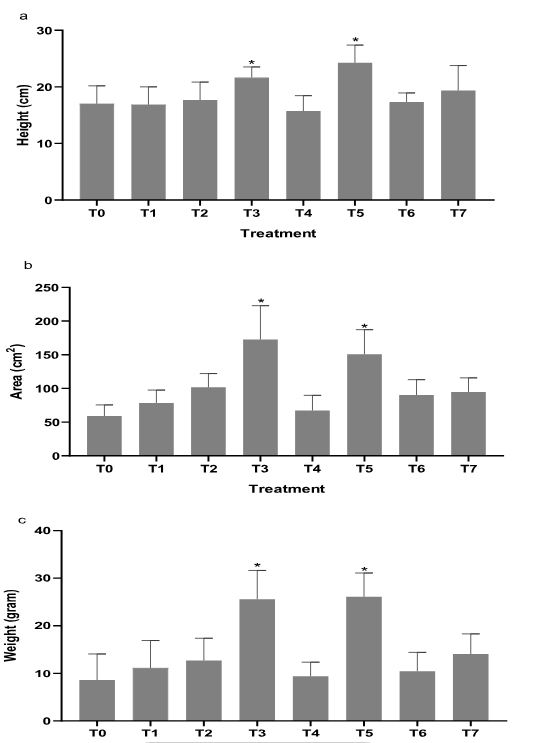
Fig. 1. Plant height (a), Leaf area (b), and Fresh weight (c) of spinach plant under control and different treatment conditions.
The application of sludge as fertilizer has mainly resulted in improved morpho-physiological performance, growth and yield of crops. The application of the two organic treatments (T3 and T5) considerably enhanced all of the measured yield parameters of spinach, including plant height, total fresh weight, yield, and dry matter yield of leaves. Improved growth and yield attributes in T3 and T5 might be attributed to their composition. T5 contained organic manure, cattle dung compost and potassium metabolizing bacteria and phosphate solubilizing bacteria, while T3 contained all components of T5 with neem oil and neem cake. Several reports have provided evidence to support the advantageous impact of sludge on crop yield and its various components. In a prior investigation, a substantial rise in the height of plants, the greenness index, and the fresh weight of spinach leaves was observed upon the application of fertilizer in combination with Ganga sewage sludge (Swain et al., 2020). In another study, the application of sewage sludge alone or in combination with inorganic fertilizers was found to significantly increase the biomass of spinach (Roy et al., 2013). In comparison to the control sample, the application of organo-mineral fertilizers derived from sewage sludge resulted in noteworthy enhancements of 75-138%, 96-138%, and 23-54% in fresh mass of rape, maize, and sunflower, respectively (Kominko et al., 2022).
The application of solid sewage as a fertilizer leads to an increase in the height and dry matter of wheat compared to those cultivated using chemical fertilizers (Koutroubas et al., 2014). Increasing the application rate of sewage sludge (up to 40 t ha −1 ) increased the straw and grain yield of wheat (Özyazıcı, 2013; Koutroubas et al., 2014). Overall organic amendments including sludge-based organic manures have been proved fruitful in enhancing growth and yields of various crops (Abbas et al., 2024; Bai et al., 2024; Ankit et al., 2024; Sujatha et al., 2024; Balkrishna et al., 2024; Balkrishna et al., 2024). The utilization of sludge has been determined to have a positive impact on various soil properties, like an increase in the ammonium-N content, cation exchange capacity, and organic carbon content in soil (Antolín et al., 2005; Mendoza et al., 2006). Sludge has also been known to result in improving porosity, gas permeability and stability of the aggregates of soil particles (Ma et al., 2022).
Chlorophyll Content. No significant difference was observed in the chlorophyll content in terms of SPAD value as determined by the SPAD meter. The SPAD value was found to be in the range of 28 to 33 (Table 2). Sewage sludge amended soil was found to result in an increase in chlorophyll content in Solanum melongena (eggplant) (Kumar and Chopra 2016), Phaseolus vulgaris (French bean) (Kumar and Chopra 2014) and Beta vulgaris var. saccharifera (sugar beet) and Triticum aestivum (wheat) (Yilmaz and Temizgül 2012). Sewage sludge compost applications resulted in a significant increase in the chlorophyll content in sawtooth oak (Quercus acutissima) and Japanese red pine (Pinus densiflora) (Song and Lee 2010).
Table 2: Chlorophyll content of spinach leaves under control and treatment conditions.
| Treatment | SPAD value |
|---|---|
| T0 | 33.90 ± 4.43 |
| T1 | 30.98 ± 2.39 |
| T2 | 33.96 ± 2.44 |
| T3 | 33.16 ± 2.58 |
| T4 | 33.44 ± 2.15 |
| T5 | 30.59 ± 2.93 |
| T6 | 33.40 ± 3.15 |
| T7 | 32.73 ± 2.32 |
Iron and Other Micronutrient Analysis. Spinach is often consumed as an iron supplement (Morelock and Correll 2003). The content of iron was found to be more than thrice (134 to 248 mg/kg) in different treatments as compared to the control plants (41 mg/kg) (Table 3). The highest content of iron was found in treatment T4, followed by T2. Thus, the higher content of Fe obtained by the organic amendment treatments given in the study further enhances the nutritional potential of the spinach. Sodium, phosphorus, calcium, and potassium were also found to be higher in all the treatments as compared to the control sample. No difference in the content of magnesium was found between treatments and control. The application of 20 tonnes of Ganga sewage sludge per hectare was found to significantly increase the micronutrient content in spinach leaves except phosphorus and manganese (Swain et al., 2020). Similarly, sewage application was found to enhance micro and macro nutrients, including N, P, K, Fe, Mn, Cu, Zn, Ca and Mg content in leaves of cucumber plants (Hussein, 2009).
Table 3: Content of micronutrients (mg/kg) in spinach leaves in control and treated plants.
| Fe | Na | Mg | P | K | Ca | |
|---|---|---|---|---|---|---|
| T0 | 41.4058 | 855.76 | 701.41 | 298.78 | 2370.52 | 110.48 |
| T1 | 145.0253 | 1316.59 | 630.42 | 1026.56 | 4150.34 | 182.84 |
| T2 | 193.1127 | 1312.36 | 646.95 | 1233.78 | 4408.68 | 154.22 |
| T3 | 134.0604 | 1440.02 | 665.49 | 979.13 | 4456.47 | 145.44 |
| T4 | 248.8215 | 1501.27 | 749.07 | 958.01 | 4381.43 | 210.15 |
| T5 | 165.0993 | 1345.38 | 760.68 | 1060.36 | 4338.07 | 214.67 |
CONCLUSIONS
Sewage sludge is a residual material that is produced during the process of treating wastewater. As the expenses associated with commercial fertilizers continue to escalate and the global production of sewage sludge reaches staggering amounts, the practice of land application has emerged as a desirable method for disposing of this waste (de Melo et al., 2007). The sludge-based organic amendments used were found to enhance the overall growth performance of spinach and its primary nutraconstituent, i.e. iron. The present study confirms the safe use of sludge-based biofertilizer for enhancing the agronomic performance of spinach and thus points towards its potential use in agriculture. This may be mainly employed to handle a large amount of solid waste by boosting new, cleaner technologies, recycling waste, and generating a safe environment by applying organic fertiliser to soil. In addition to enhancing soil structure and promoting nutrient recycling, the utilization of sludge in agriculture offers the potential for energy conservation when compared to the utilization of synthetic fertilizers. The use of sewage sludge as an excellent fertilizer supplement for crop development (spinach) can be followed, although caution should be used due to the presence of heavy metals and contaminants.
Acknowledgments. The authors would like to express their heartfelt appreciation to Revered Swami Ramdev ji for his unflinching support and guidance. The Patanjali Herbal Research Department and the Patanjali Research Foundation in Haridwar, India, are also thanked for providing essential facilities and assistance throughout this study.
REFERENCES
Abbas, G., Chauhan, V., Dash, U., Keprate, A., Madiwalar, A. F., Balu, R. N. & Banoo, R. (2024). Effect of organic manures on growth and yield of Raphanus sativus L. under Melia based agroforestry system: A case study from North Western Himalaya. Biological Forum – An International Journal, 16(1), 01–06.
Angin, I., Aslantas, R., Gunes, A., Kose, M., & Ozkan, G. (2017). Auswirkungen von Klärschlamm als Zuschlagsstoff auf einzelne Bodeneigenschaften sowie Wachstum, Ertrag und Nährstoffgehalt bei Himbeeren (Rubus idaeus L.). Erwerbs-Obstbau, 59(2), 93–99.
Ankit, Singh, B., Rathor, R. & Sharma, M.M. (2024). Effect of Different Organic Inputs for Growth and Yield Characteristics of Pea (Pisum sativam L.) cv. Kashi Nandini. Biological Forum – An International Journal, 16(1), 183–186.
Antolín, M. C., Pascual, I., García, C., Polo, A., & Sánchez-Díaz, M. (2005). Growth, yield and solute content of barley in soils treated with sewage sludge under semiarid Mediterranean conditions. Field Crops Research, 94(2–3), 224–237.
Bai, L., Bundela, M. K., Singh, P., Meena, D. C., Maurya, R. P. & Sharma, A. (2024). Effect of Biofertilizers and Organic Manures on Growth, Yield and Quality of Tomato (Solanum lycopersicum L.). Biological Forum – An International Journal, 16(1), 136–140.
Bai, Y., Zang, C., Gu, M., Gu, C., Shao, H., Guan, Y., Wang, X., Zhou, X., Shan, Y., & Feng, K. (2017). Sewage sludge as an initial fertility driver for rapid improvement of mudflat salt- soils. Science of the Total Environment, 578, 47–55.
Balkrishna, A., Sharma, N., Gautam, A. K., Arya, V., Khelwade, V. (2024). Enhancement of Wheat (Triticum aestivum L.) Growth and Yield Attributes in a Subtropical Humid Climate through Treated Ganga Sludge- based Organic Fertilizers. Recent Advances in Food, Nutrition & Agriculture, 15(3), 178–192.
Balkrishna, A., Gautam, A. K., Sharma, N., Arya, V., and Khelwade, V. (2024). Growth and Yield Enhancement of Carrot (Daucus carota L.) through Treated Ganga Sludge- based Organic Fertilizers. Biological Forum – An International Journal, 16(3), 175-180.
Das, S. (2011). Cleaning of the Ganga. Journal of the Geological Society of India, 78(2), 124–130.
de Melo, W. J., de Stéfani Aguiar, P., de Melo, G. M. P., & de Melo, V. P. (2007). Nickel in a tropical soil treated with sewage sludge and cropped with maize in a long-term field study. Soil Biology and Biochemistry, 39(6), 1341–1347.
Dwivedi, S., Mishra, S., & Tripathi, R. D. (2018). Ganga water pollution: A potential health threat to inhabitants of Ganga Basin. Environment International, 117, 327–338.
Hernández, T., Moreno, J. I., & Costa, F. (1991). Influence of sewage sludge application on crop yields and heavy metal availability. Soil Science and Plant Nutrition, 37(2), 201–210.
Hudcová, H., Vymazal, J., & Rozkošný, M. (2019). Present restrictions of sewage sludge application in agriculture within the European Union. Soil and Water Research, 14(2), 104–120.
Hussein, A. H. A. (2009). Impact of sewage sludge as organic manure on some soil properties, growth, yield and nutrient contents of cucumber crop. Journal of Applied Sciences, 9(8), 1401–1411.
Jamil, M., Qasim, M., Umar, M., & Subhan, A. (2004). Impact of organic wastes (bagasse ash) on the yield of wheat (Triticum aestivum L.) in a calcareous soil. International Journal of Agriculture & Biology, 6(3), 468–470.
Kominko, H., Gorazda, K., & Wzorek, Z. (2022). Effect of sewage sludge-based fertilizers on biomass growth and heavy metal accumulation in plants. Journal of Environmental Management, 305, 114417.
Koutroubas, S. D., Antoniadis, V., Fotiadis, S., & Damalas, C. A. (2014). Growth, grain yield and nitrogen use efficiency of Mediterranean wheat in soils amended with municipal sewage sludge. Nutrient Cycling in Agroecosystems, 100(2), 227–243.
Kumar, V., & Chopra, A. K. (2014). Accumulation and translocation of metals in soil and different parts of French bean (Phaseolus vulgaris L.) amended with sewage sludge. Bulletin of Environmental Contamination and Toxicology, 92(1), 103–108.
Kumar, V., & Chopra, A. K. (2016). Agronomical performance of high yielding cultivar of eggplant (Solanum melongena L.) grown in sewage sludge amended soil. Research in Agriculture, 1(1), 1.
Manyatsi, A., & Simelane, G. (2017). The effect of organic mulch on the growth and yield of spinach (Spinacia oleracea L.). International Journal of Environmental and Agriculture Research, 3(6), 53–56.
Ma, D., Wang, Y., Ye, Y., Ge, X., & Lu, X. (2022). Effects of three sludge products from co- treatment of wastewater on the soil properties and plant growth of silty loam. International Journal of Environmental Research and Public Health, 19(7), 4385.
Mendoza, J., Garrido, T., Castillo, G. & San Martin, N. (2006). Metal availability and uptake by sorghum plants grown in soils amended with sludge from different treatments. Chemosphere, 65(11), 2304–2312.
Merwin, H. D., & Peech, M. (1951). Exchangeability of soil potassium in the sand, silt, and clay fractions as influenced by the nature of the complementary exchangeable cation. Soil Science Society of America Journal, 15(C), 125–128.
Morelock, T. E., & Correll, J. C. (2003). Spinach.
Olsen, S. R. (1954). Estimation of available phosphorus in soils by extraction with sodium bicarbonate (No. 939). U.S. Department of Agriculture.
Paliya, S., Mandpe, A., Kumar, S., & Kumar, M. S. (2019). Enhanced nodulation and higher germination using sludge ash as a carrier for biofertilizer production. Journal of Environmental Management, 250, 109523.
Rai, B. (2013). Pollution and conservation of Ganga River in modern India. International Journal of Scientific and Research Publications, 3(4), 1–4.
Rehman, R. A., Rizwan, M., Qayyum, M. F., Ali, S., Zia-ur-Rehman, M., Zafar-ul-Hye, M., Hafeez, F., & Iqbal, M. F. (2018). Efficiency of various sewage sludges and their biochars in improving selected soil properties and growth of wheat (Triticum aestivum). Journal of Environmental Management, 223, 607–613.
Roy, T., Singh, R. D., Biswas, D. R., & Patra, A. K. (2013). Effect of sewage sludge and inorganic fertilizers on productivity and micronutrient accumulation by palak (Beta vulgaris) and their availability in a Typic Haplustept. Journal of the Indian Society of Soil Science, 61(3), 207–218.
Samaras, V., Tsadilas, C. D., & Stamatiadis, S. (2008). Effects of repeated application of municipal sewage sludge on soil fertility, cotton yield, and nitrate leaching. Agronomy Journal, 100(3), 477–483.
Seleiman, M. F., Santanen, A., & Mäkelä, P. S. A. (2020). Recycling sludge on cropland as fertilizer – advantages and risks. Resources, Conservation and Recycling, 155, 104647.
Singh, R., & Singh, G. S. (2020). Integrated management of the Ganga River: An ecohydrological approach. Ecohydrology and Hydrobiology, 20(2), 153–174.
Song, U. & Lee, E. J. (2010). Ecophysiological responses of plants after sewage sludge compost applications. Journal of Plant Biology, 53(4), 259–267.
Subbiah, B. V., & Asija, G. L. (1956). A rapid procedure for the estimation of available nitrogen in soils. Current Science, 25(8), 259–260.
Sujatha, K. B., Paramaguru, P., Somasundaram, E., Renuka Devi, A., Nageswari, R., & Senthamizh Selvi, B. (2024). Organic Amendments on Fruit Yield and Quality of Banana cv. Neypoovan. Biological Forum – An International Journal, 16(6), 101–104.
Swain, A., Singh, S. K., Mohapatra, K. K., & Patra, A. (2020). Effect of sewage sludge application on yield, nutrients uptake and nutrient use efficiency of spinach (Spinacia oleracea L.). Annals of Plant and Soil Research, 22, 305–309.
Urbaniak, M., Wyrwicka, A., Tołoczko, W., Serwecińska, L., & Zieliński, M. (2017). The effect of sewage sludge application on soil properties and willow (Salix sp.) cultivation. Science of the Total Environment, 586, 66–75.
Walkley, A., & Black, I. A. (1934). An examination of the Degtjareff method for determining soil organic matter, and a proposed modification of the chromic acid titration method. Soil Science.
Watanabe, M., & Ayugase, J. (2015). Effect of low temperature on flavonoids, oxygen radical absorbance capacity values and major components of winter sweet spinach (Spinacia oleracea L.). Journal of the Science of Food and Agriculture, 95(10), 2095–2104.
Yilmaz, D. D., & Temizgül, A. (2012). Assessment of arsenic and selenium concentration with chlorophyll contents of sugar beet (Beta vulgaris var. saccharifera) and wheat (Triticum aestivum) exposed to municipal sewage sludge doses. Water, Air, and Soil Pollution, 223(6), 3057–3066.
Zhao, X., Iwamoto, T., & Carey, E. E. (2007). Antioxidant capacity of leafy vegetables as affected by high tunnel environment, fertilisation and growth stage. Journal of the Science of Food and Agriculture, 87(14), 2692–2699.
Zuo, W., Gu, C., Zhang, W., Xu, K., Wang, Y., Bai, Y., Shan, Y., & Dai, Q. (2019). Sewage sludge amendment improved soil properties and sweet sorghum yield and quality in a newly reclaimed mudflat land. Science of the Total Environment, 654, 541–549.
How to cite this article: Acharya Balkrishna, Ajay Kumar Gautam, Nidhi Sharma, Vedpriya Arya and Rohini Bhat (2026). Impact of Sludge-Based Organic Amendments on Growth Performance of Spinach (Spinacia oleracea). AgriBio Innovations, 3(1): 01-08.